
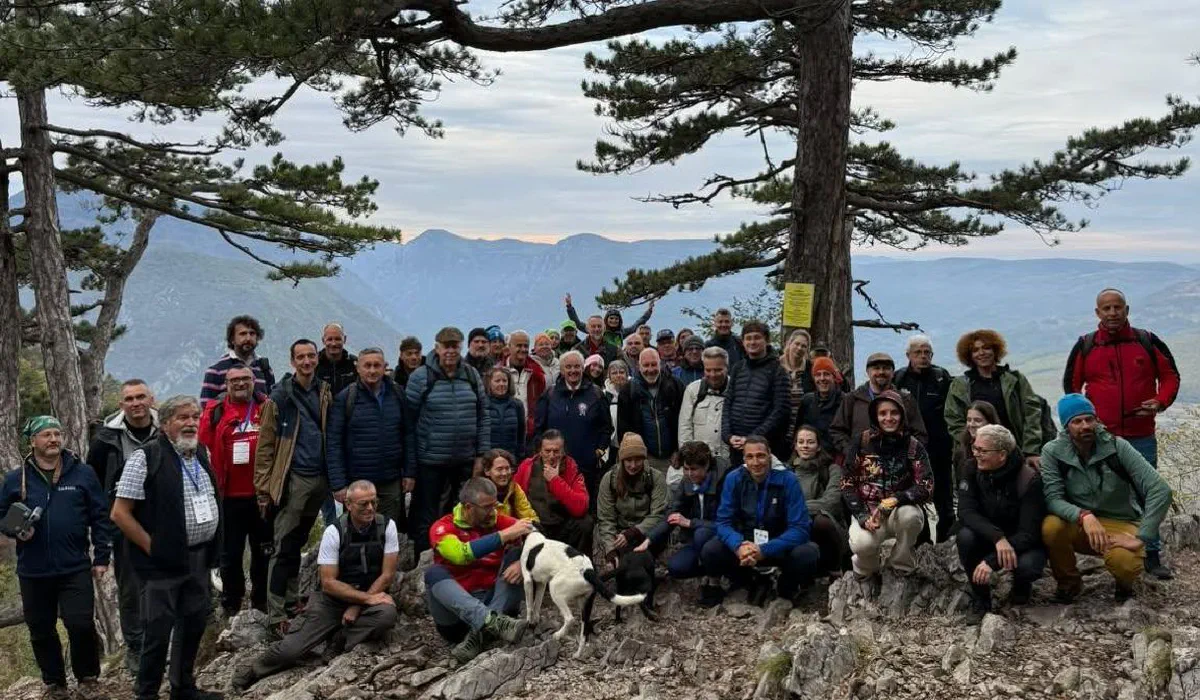
Delegates of the 57th ERA conference in Tara National Park, above the Drina valley. Photo: ERA
From 15 to 18 October 2026, the member organisations of the European Hiking Federation (ERA, “Hiking Europe”) met in Bajina Bašta, western Serbia, for the 57th annual conference. The host was the Mountaineering Association of Serbia (Planinarski Savez Srbije, PSS). The programme combined the General Meeting, the Know-How Sessions, workshops and, of course, hikes.
Our club was not there this year, but we follow closely what is decided in the federation we have belonged to since 2024. The message of the conference was simple: the federation’s strength lies in its member organisations, their expertise and their willingness to work together.
Six Teams for a more active federation
ERA wants to be a federation in which members take part directly. In Bajina Bašta it presented its new structure of six Teams: trails and environment, digital innovation, youth, sports, governance, and relations with the European institutions. The answers to the member questionnaires showed what organisations expect from the federation and how they want to contribute. The conclusion: taking part should be practical and manageable. Organisations are invited to nominate people for the Teams and to take on specific tasks.
Friday, 16 October: the Know-How Sessions
After the presentation of the ERA Teams, the morning was about digital maps and monitoring hiking:
- PTTK, the Polish hiking organisation, presented its trail records system and the websites built on it (Marian Jurak);
- Mapy.com, the federation’s new partner, showed how digital maps and reliable local information make hiking safer (Jakub Zmrzlík);
- Hoge Kempen National Park in Belgium uses artificial intelligence to monitor the number of hikers on its trails (Johan Van Den Bosch);
- free access to nature and forest legislation in Germany (Liane Jordan);
- European WanderMonitor, an application for hiking data at European level (Steen Kobberø-Hansen).
Then came the session on young people: organisations interested in working with youth, ambassadors, mentoring and projects, building on the Erasmus+ project PATH (Rúben Jordão). Anni Borrmann presented the Stoneman Miriquidi Hike, a new and demanding trail across the German-Czech border, with the pros and cons of a cross-border trail and the effort to attract young adults to hiking.
Saturday, 17 October: the General Meeting
The agenda covered the Board’s report, the 2025 finances, the federation’s strategy and the budget for 2026 and 2027. The main decisions:
- Three new members: the regional hiking committee of Sud Provence-Alpes-Côte d’Azur (France) and the Kosovo Mountaineering and Sport Climbing Federation, both full members, and the Mountaineering Association of Republika Srpska, whose application was decided by the General Meeting. FFRandonnée Nouvelle-Aquitaine left the federation from 2026.
- The EUMA–ERA Charter for Hiking and Mountain Trails in Europe. The Charter sets out a shared vision of the two European federations for protecting, developing and sustainably managing trails: responsible access to nature, environmental protection, trail quality, volunteer involvement and cooperation with public authorities.
- Voluntary contributions: the federation’s constitution now lets member organisations pay an additional fee if they wish, for a specific purpose or for the general support of the federation.
- A new auditor: Ellen Kitter, nominated by the Deutscher Wanderverband.
- The 2027 membership fee, adjusted for inflation: 732 euro for full members.
After the meeting, Nenad Lečić (Mountaineering Association Tara) presented STANDOUT, European Outdoor Cities, an Erasmus+ Sport project that helps cities assess and improve their opportunities for outdoor activity, with a framework of 4 pillars, 12 categories and 65 indicators and a 19-question Quick Check. This was followed by the status of the federation’s Erasmus+ projects and a discussion of future projects. The competition for Erasmus+ funding is growing, and projects need clear relevance, genuine European added value and measurable impact. Ideas presented included research on the economic value of trails, accessibility and inclusion, and heritage storytelling along the E4 in Greece.
Looking back at EURORANDO 2026
The meeting also reviewed EURORANDO 2026, held from 20 to 27 September in the Ore Mountains on the German-Czech border. Highlights included the “Stone Heart of Europe”, built from stones participants brought from their home countries, tree planting, and the final cross-border parade of about 3,000 walkers on European Walking Day.
Serbia on foot
The Serbian hosts made sure the delegates also got to know the area. On Friday, the excursion visited Drvengrad, the wooden village built by Emir Kusturica, continued with the famous Mokra Gora narrow-gauge railway and ended with a walk on the European long-distance path E7. On Saturday afternoon, the delegates hiked through the forests of Tara National Park to the Banjska Stena viewpoint above the Drina valley.
What comes next
- The 2027 General Meeting will be held in Elbasan, Albania.
- For 2028 or 2029, the Siebenbürgischer Karpatenverein (Transylvanian Carpathian Society) has proposed holding the General Meeting in Romania.
See you in the mountains!